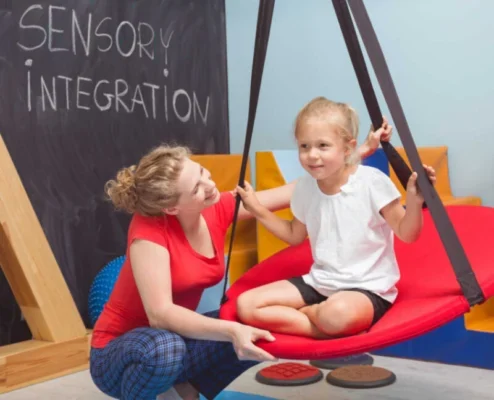
The play
In its January/February 2018 issue, the American Journal of Occupational Therapy published Efficacy of Occupational Therapy Using Ayres Sensory Integration®: A Systematic Review, led by Roseann Schaaf of Thomas Jefferson University. Ayres Sensory Integration, named for occupational therapist A. Jean Ayres, is a specific clinical intervention delivered by trained therapists using structured sensory-motor equipment, distinct from the general category of 'sensory toys' sold directly to consumers. This review asked what the clinical trial evidence for that specific therapy actually shows.
What the evidence says
Only five studies met the review's inclusion criteria: three randomized controlled trials, one retrospective analysis, and one single-subject design, published between 2007 and 2015, and every one of them studied children with autism specifically. An independent index of the review confirms this same study count and population. The authors describe the evidence as strong for improving individually generated participation goals measured by Goal Attainment Scaling, moderate for reductions in autistic behaviors and caregiver assistance with self-care, and emerging but insufficient for play, sensory-motor, language skills, and caregiver assistance with social skills.
Age fit and safety
Every study in this review's evidence base involved children with autism; the review states no findings for children without an autism diagnosis and no findings for the sensory toys marketed broadly to consumers rather than delivered as clinical therapy. It reports no safety concerns, since it evaluates therapeutic efficacy, not product hazards, and it should not be read as evidence about any commercial toy.
What to look for
Editorially, the review's narrow, autism-specific evidence base is the key fact a caregiver should carry into any product labeled 'sensory,' since this systematic review does not evaluate consumer sensory toys at all and its findings cannot be transferred to them. A toy marketed with a phrase like 'sensory integration' is not automatically backed by this therapy's own clinical evidence unless the seller specifies which population and outcome that evidence covers.
- Is a 'sensory integration' product claim referencing this clinical therapy, or borrowing its name for an unrelated consumer toy?
- If a child has a diagnosis, has an occupational therapist actually recommended a specific approach, rather than a retailer's category label?
- Does the marketed outcome match one this review found strong evidence for, or one it found insufficient evidence for?
Five studies, all in one population, is a real but limited evidence base; the review's own caution about consumer sensory-toy claims is worth repeating whenever that language shows up on packaging.
Sources & reading trail
Gives the five-study, autism-specific evidence base and the graded strength of evidence for each outcome category.
Source published: 1 January 2018 · Retrieved: 16 September 2026
Independently confirms the review's study count, population, and journal record.
Source published: 1 January 2018 · Retrieved: 16 September 2026
Standards, recall notices, studies and records establish the entry; the what-to-look-for reading is Toy Almanac editorial analysis. This retrospective draft does not imply the site published on the event date.