
The play
High-powered magnet sets, small ball- or cube-shaped rare-earth magnets sold as building or stress-relief toys, are strong enough that two swallowed pieces can pull together through intestinal walls. CPSC's first mandatory standard for these sets took effect in 2012 and was vacated by the U.S. Court of Appeals for the Tenth Circuit on 22 November 2016, according to the agency's later final rule. The market reopened until CPSC issued a new mandatory standard, codified at 16 CFR part 1262, applying to products manufactured after 21 October 2022.
What the evidence says
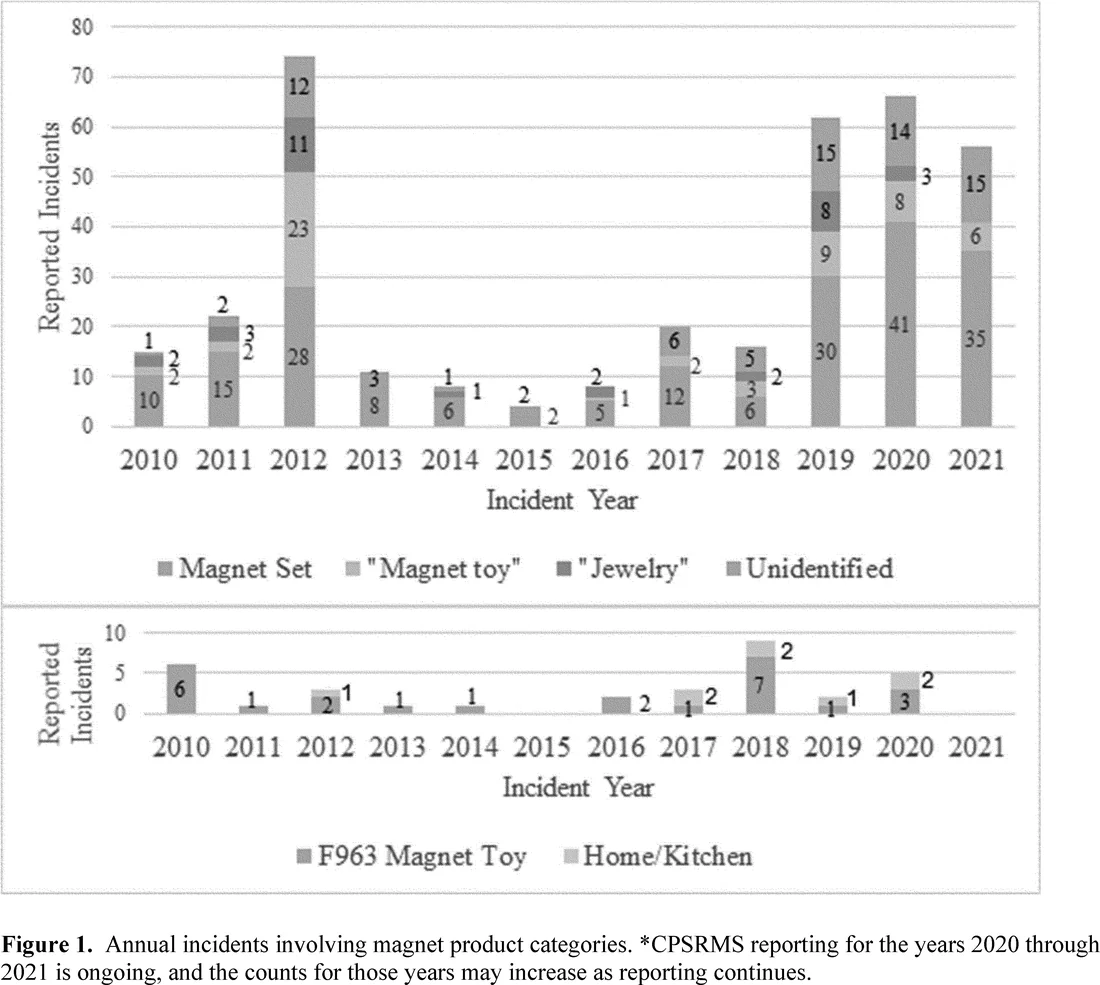
The regulation text defines a hazardous magnet as one that fits entirely inside CPSC's small-parts test cylinder and has a flux index, a laboratory measure combining magnetic strength and size, of 50 kG²mm² or more; a loose or separable magnet in a covered product must test below that figure. The final rule's own preamble states that CPSC's review of incident data, alongside other researchers' assessments of emergency-department and poison-center records, found magnet-ingestion estimates fell during the years the 2014 rule was active and rose again after the 2016 vacatur, citing roughly 2,300 annual emergency-department-treated ingestions before that rule and about 1,300 annually while it was in force. This is the agency's own retrospective accounting from surveillance data, not a controlled study isolating the rule's effect.
Age fit and safety
The rule sets no age grading; it removes magnets meeting the flux-index and size test from the market for everyone, addressing a hazard the final rule's own history ties to both young children and teenagers who mistake magnets for tongue or lip jewelry. The 2016 vacatur and the 2022 rule are two separate regulatory actions six years apart, not phases of one continuous rule, a distinction worth keeping straight given how often magnet-set coverage compresses the two.
What to look for
This is editorial guidance drawn from the rule's own scope. Because the standard applies to magnets manufactured after October 2022, a secondhand or older magnet-set toy is not guaranteed to meet the current flux-index limit, and a marketplace purchase outside familiar retail channels is one common way an older or noncompliant set can still reach a household. A set marketed for adults, such as a desk toy or puzzle, deserves the same scrutiny in a household with children as one marketed as a toy.
- Is a magnet building or desk set kept away from young children and pre-teens in the household?
- Was it bought from a retailer likely to carry current, compliant stock rather than older inventory?
- Would a caregiver think to mention possible magnet ingestion to a doctor if a child had sudden abdominal pain?
A flux-index limit is a specific, testable line the agency drew after watching what happened when an earlier rule disappeared, and that history, not a set's marketed age range, is the clearest guide to why the current limit exists.
Sources & reading trail
The regulation text states the 50 kG²mm² flux-index limit for a hazardous magnet fitting the small-parts cylinder and applies the rule to products manufactured after 21 October 2022.
Source published: 21 September 2022 · Retrieved: 16 September 2026
CPSC's final rule states the Tenth Circuit vacated the agency's 2014 magnet-set rule on 22 November 2016 and documents ingestion-rate changes before, during, and after that vacatur.
Source published: 21 September 2022 · Retrieved: 16 September 2026
Standards, recall notices, studies and records establish the entry; the what-to-look-for reading is Toy Almanac editorial analysis. This retrospective draft does not imply the site published on the event date.