The play
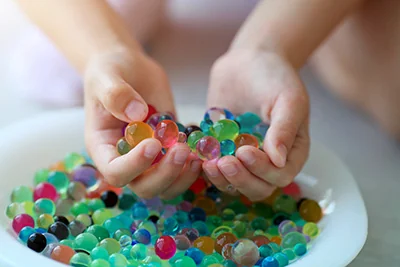
Water beads are small polymer spheres, sold as sensory or craft toys, that start no bigger than a peppercorn and swell to marble size or larger after hours soaking in water. They come packaged as jars of dry pellets or pre-soaked kits, marketed for building, sorting, and squeezing play. On 21 August 2025 the U.S. Consumer Product Safety Commission approved a new federal safety standard for water-bead toys, described in the agency's own news release as intended to reduce injury and death among young children.
What the evidence says
CPSC's release states that from 2017 through 2022 emergency departments treated roughly 6,300 water-bead ingestion injuries, and it references at least one 2023 death of a 10-month-old child. The agency's business guidance spells out what the rule requires: a dry bead small enough to fit CPSC's small-parts test cylinder must, once fully expanded, be too large to pass through a 5.0 millimeter funnel or sieve gauge; a covered toy may not release more than 325 micrograms of extractable acrylamide from 100 small beads or one large bead; and packaging, containers, and the toy itself need prominent warning labels. These are the agency's own stated limits, not an independent laboratory's findings about any single product on a shelf.
Age fit and safety
The standard sets no minimum age; instead it changes the physical and chemical limits every covered water-bead product must meet, regardless of the age printed on the box. Manufacturers and importers must file a Children's Product Certificate citing the standard, formally 16 C.F.R. 1250.4, for water beads manufactured or imported on or after 12 March 2026, per the business guidance. A bead toy already in a home, a donation bin, or a resale shelf may predate the rule entirely and carry none of these limits.
What to look for
This is editorial guidance built on the rule's own scope, not a new finding. Check a water-bead product's packaging for a manufacture date at or after March 2026 and for the warning language the rule now requires; a jar with no warning at all is worth a second look. Because the standard addresses expansion size and acrylamide rather than supervision, an adult in the room is still what keeps loose or soaking beads away from a mouth, ear, or nose, the routes CPSC's own injury count describes.
- Does the packaging show a manufacture date, and does it fall on or after 12 March 2026?
- Is the required warning label present on the toy itself, not just the outer box?
- Is play supervised closely enough that a dropped or swallowed bead would be caught quickly?
A federal size-and-chemistry limit narrows one part of the water-bead hazard without removing the need for direct supervision, and reading the rule's own scope, rather than a product's marketing, is the surest way to know what it actually promises.
Sources & reading trail
CPSC's own release states the rule's approval date, the emergency-department injury and death figures, and the rule's size, acrylamide, and labeling goals.
Source published: 21 August 2025 · Retrieved: 16 September 2026
CPSC's business guidance states the rule's effective date, the funnel and sieve expansion test, the 325-microgram acrylamide limit, and the certification and labeling requirements.
Source published: Not established · Retrieved: 16 September 2026
Standards, recall notices, studies and records establish the entry; the what-to-look-for reading is Toy Almanac editorial analysis. This retrospective draft does not imply the site published on the event date.