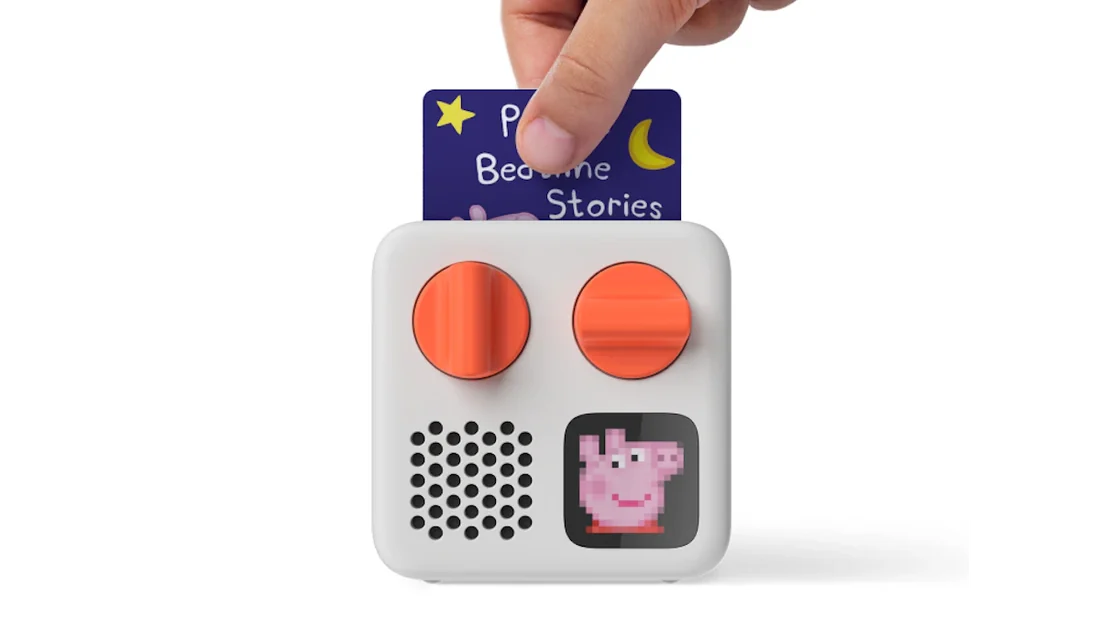
The play
The Yoto Mini is a small, screen-free audio player: a child inserts a Yoto Card into a slot to play stories, music, or sleep sounds, using physical buttons for volume and chapter control. Yoto's own product page, retrieved 16 September 2026, markets it for ages 3 to 12 and up, alongside a required choking-hazard warning that the toy's small parts are not suitable for children under 36 months.
What the evidence says
Yoto's product page states, in its own words, that the Mini has no microphone, no camera, and no ads, and describes offline use: once Yoto Cards are downloaded over Wi-Fi, the Mini can store more than 500 hours of audio for playback without a connection. The same page answers a support question about longevity by stating that security updates will be provided until at least 31 January 2030. Yoto's separate privacy policy written for children reiterates the no-camera claim directly to young readers, saying Yoto players do not have eyes or a camera, while explaining that a parent can choose to share a child's voice recording with Yoto for its Make Your Own card feature, and that Yoto says it sometimes listens to those specific recordings to check that they do not break its rules. Both pages are the manufacturer's own statements about its own product; neither page cites, links to, or summarizes an independent security audit of the Yoto Mini's hardware or software, so a caregiver reading them is reading a company's account of its own design choices, not third-party verification of them.
Age fit and safety
Yoto states the Mini suits ages 3 and up, with the manufacturer's own choking-hazard label excluding children under 36 months because of small parts, consistent with a standard warning rather than an independent test result. No source reviewed for this entry independently verifies the no-microphone, no-camera claim beyond the company's own statement.
What to look for
This is an editorial reading of the manufacturer's own pages, offered as a model for how to read any connected-toy company's safety claims, not as a verified audit of this product.
- Does a manufacturer's no-microphone or no-camera claim appear on both the product page and the privacy policy, worded consistently?
- Does the company state an end date for security updates, and is that date still years away?
- When a feature depends on voice recordings, does the company say who else, if anyone, may listen to them?
A manufacturer's own safety and privacy statements are a reasonable starting point for a caregiver's own check, but, absent an independent audit, they remain the company's account of its own product rather than outside verification of it.
Sources & reading trail
Manufacturer's own product page stating no microphone or camera, offline storage capacity, age range, choking-hazard warning, and the security-update horizon to 31 January 2030.
Source published: Not established · Retrieved: 16 September 2026
Manufacturer's child-directed privacy policy repeating the no-camera claim and describing how voice recordings from the Make Your Own feature may be reviewed.
Source published: Not established · Retrieved: 16 September 2026
Standards, recall notices, studies and records establish the entry; the what-to-look-for reading is Toy Almanac editorial analysis. This retrospective draft does not imply the site published on the event date.