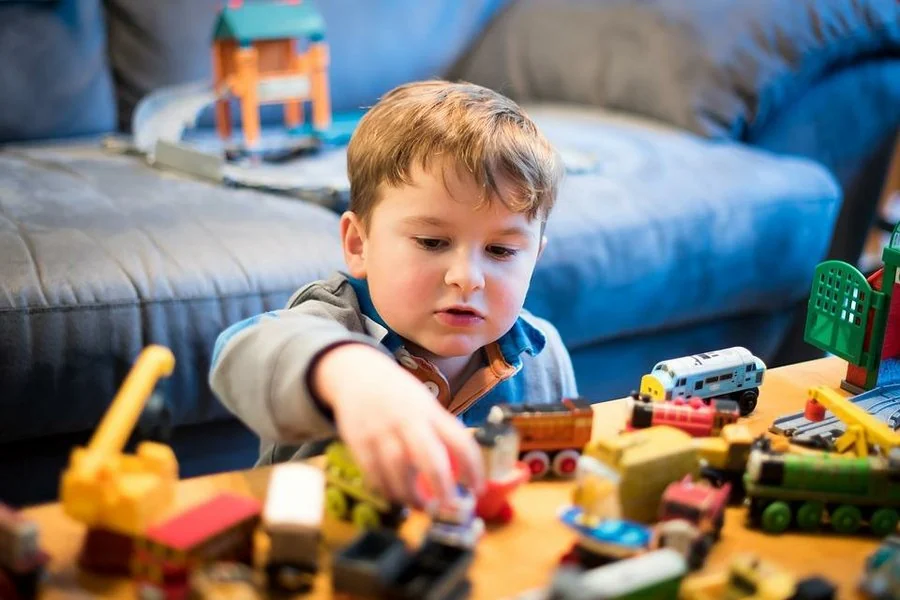
The play
Posted online in November 2017 and printed in the February 2018 issue of Infant Behavior and Development, The influence of the number of toys in the environment on toddlers' play came from an occupational therapy research team at the University of Toledo led by Carly Dauch. Thirty-six toddlers each had two individually supervised, unstructured free-play sessions: one with four toys available, one with sixteen. The researchers then coded what the child actually did with the toys in each condition.
What the evidence says
With only four toys out, the same toddlers showed fewer separate incidences of toy play, but each incidence lasted longer, and children used toys in a greater variety of ways, all statistically significant differences reported by the authors (for example, longer play durations at Z=2.828, p=0.005). Europe PMC's indexed record of the study confirms the same 36-participant, two-condition design and result set drawn directly from the published abstract. The authors' own interpretation is that fewer toys let a toddler settle into one object long enough to explore it in more ways, rather than sampling briefly across many options.
Age fit and safety
The study enrolled toddlers, a narrower age band than the word 'toddler' sometimes covers loosely, and it measured play behavior in a supervised session, not a hazard or safety outcome. It says nothing about which toys are safe with fewer or more choking parts present, and its four-versus-sixteen comparison does not establish a specific ideal count; the authors describe a direction, not a number a caregiver should aim for at home.
What to look for
Editorially, this single 36-child study is a reasonable basis for a caregiver to try rotating a smaller toy selection at a time rather than leaving every toy accessible at once, since that is the condition the study actually tested. It is not, by itself, evidence for a specific number like four or sixteen as a target, and it should not be read as a rule about every play setting, material, or age the study did not include.
- Would putting some toys away and rotating them change how long this child stays with any one of them?
- Is 'more variety of toys out' actually producing more variety of play, or just more switching?
- Does a claimed 'ideal toy count' cite this study's actual four-versus-sixteen comparison, or invent a number it never tested?
Read narrowly, the finding supports a simple, low-cost habit, having fewer toys within reach at a time, while leaving the exact count, the age range, and the setting open for further study beyond this one sample.
Sources & reading trail
Gives the 36-participant, four-toy-versus-sixteen-toy design and the reported statistical results for play incidence, duration, and variety.
Source published: 27 November 2017 · Retrieved: 16 September 2026
Independently indexes the same study, journal, and abstract, corroborating the design and results.
Source published: 27 November 2017 · Retrieved: 16 September 2026
Standards, recall notices, studies and records establish the entry; the what-to-look-for reading is Toy Almanac editorial analysis. This retrospective draft does not imply the site published on the event date.