
The play
Published in Frontiers in Psychology on 27 August 2020, Is Early Spatial Skills Training Effective? A Meta-Analysis, by Weipeng Yang and colleagues, pools intervention studies that trained children in spatial skills, the ability to picture, rotate, and reason about shapes and their arrangement in space. That skill sits behind puzzles, blocks, and construction toys long marketed to parents as building spatial or 'STEM' ability, which is exactly why an independent pooled estimate of whether such training actually works matters.
What the evidence says
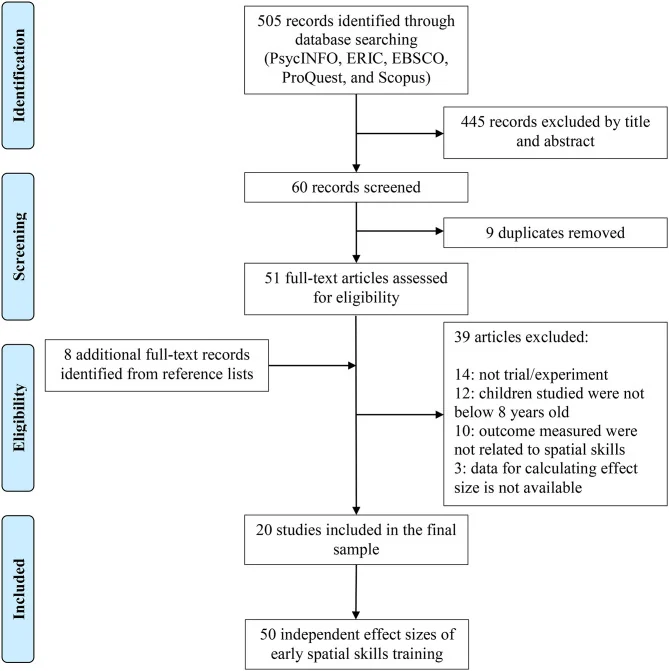
The review combined 20 intervention studies published between 2009 and 2020, yielding 50 separate effect sizes from roughly 900 children in training groups and 635 in control groups, ages newborn to eight, with about 15 percent of that pooled sample under three. Using a random-effects model, the authors report an overall effect of Hedges' g=0.96, larger than the g=0.47 found in prior meta-analyses of spatial training in general populations. The full published article also reports that effects were stronger for girls than boys in the pooled data (g=0.909 versus 0.686) and did not differ significantly by children's age, training setting, or training type.
Age fit and safety
The pooled studies span birth to eight years, with training methods including hands-on exploration, visual prompts, and gestural instruction, meaning the finding covers a range of activities rather than one product category, and it does not isolate infants or toddlers as a distinct group with their own separate result. The review reports no safety findings, since it measures learning outcomes from structured training studies, not product hazards.
What to look for
Editorially, this review supports treating hands-on spatial play, building, stacking, fitting shapes together, as a reasonably evidenced way to practice a specific cognitive skill, while stopping short of endorsing any single branded 'spatial' or 'STEM' toy the review never tested. The authors themselves note the eligible study pool was relatively small, which limits how far the pooled estimate can be generalized to every training format or age.
- Does this toy actually involve rotating, fitting, or picturing shapes, or is 'spatial' or 'STEM' just marketing language?
- Is a caregiver present to prompt and talk through the spatial task, matching how the reviewed training studies worked?
- Does a specific product claim cite this review's pooled result, or borrow its numbers without having been part of the 20 studies?
The meta-analysis is genuine evidence that spatial training can move the needle on spatial skill, measured on its own terms; it is not a certification for any particular toy that merely uses the word 'spatial' on its packaging.
Sources & reading trail
Full text giving the 20-study, 50-effect-size pooled design, the Hedges g=0.96 result, and the moderator analysis by sex and age.
Source published: 27 August 2020 · Retrieved: 16 September 2026
Publisher's article page confirming the same result set and the publication date.
Source published: 27 August 2020 · Retrieved: 16 September 2026
Standards, recall notices, studies and records establish the entry; the what-to-look-for reading is Toy Almanac editorial analysis. This retrospective draft does not imply the site published on the event date.