The play
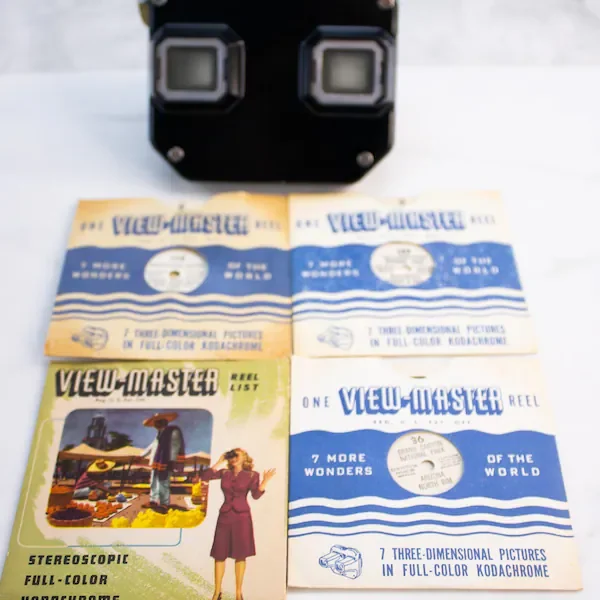
A View-Master is a hand-held stereoscope: a viewer holds it to their eyes and clicks a lever to advance a paper reel of small color photograph pairs that appear three-dimensional. The National Toy Hall of Fame's record traces the device to a chance 1938 meeting at Oregon Caves National Monument, where Harold Graves, president of Sawyer's Photographic Services, saw fellow camera enthusiast William Gruber using two cameras strapped together; by the museum's account, Gruber explained he wanted to update the stereoscopes common in 19th-century parlors with three-dimensional color slides and a new hand-held viewer, and the two struck a deal to produce it by the next morning.
What the evidence says
The museum's record states that Graves and Gruber introduced their device at the 1939 New York World's Fair before selling it through specialty photography stores, with early reels showing scenic American attractions rather than characters or stories. The toy's current manufacturer's product page corroborates the year, stating that 'since 1939, the View-Master has been delighting children.' The museum's record adds that the toy changed substantially in 1951, when View-Master acquired a competing film-strip company, Tru-Vue, along with the stereo licensing rights to Disney characters, turning a scenic-photography viewer into a licensed-entertainment product, a business event this entry treats as separate from the original 1939 design.
Age fit and safety
Neither source states a numeric age range for the original device. A View-Master is a small optical viewer with a paper reel, parts larger than a typical choking hazard but with edges and small mechanical parts a caregiver of a very young child should still check, since neither record addresses a specific hazard. The shift the museum records, from scenic reels to Disney-licensed content after 1951, is a content change rather than a physical-safety one, and this entry does not treat it as a safety finding.
What to look for
This is editorial guidance: a caregiver choosing a modern View-Master reissue can check the reel content against the child's interests, the way the museum describes scenic reels giving way to licensed characters, and can check the current box's age label rather than assume anything from the 1939 debut. A vintage viewer or reel bought as a collectible is worth handling as an heirloom rather than assuming it meets a current toy-safety label, since it predates any modern standard.
- Does the reel content, scenic, educational, or character-based, match what the child is actually interested in?
- Does a current box carry an age label the caregiver has checked against the child's age?
- Is a vintage viewer being bought for supervised or display use rather than a young child's toy box?
A shared curiosity at a national monument turned into a fairground novelty in 1939 and, after a 1951 licensing deal, into one of the century's most familiar ways for a child to see somewhere they had never been.
Sources & reading trail
National Toy Hall of Fame record for the 1938 Graves-Gruber meeting, the 1939 New York World's Fair debut, and the 1951 Tru-Vue/Disney licensing shift, plus 1999 induction.
Source published: 20 August 2021 · Retrieved: 16 September 2026
Current manufacturer's product page dates View-Master to 1939, corroborating the museum's account.
Source published: Not established · Retrieved: 16 September 2026
Standards, recall notices, studies and records establish the entry; the what-to-look-for reading is Toy Almanac editorial analysis. This retrospective draft does not imply the site published on the event date.