The play
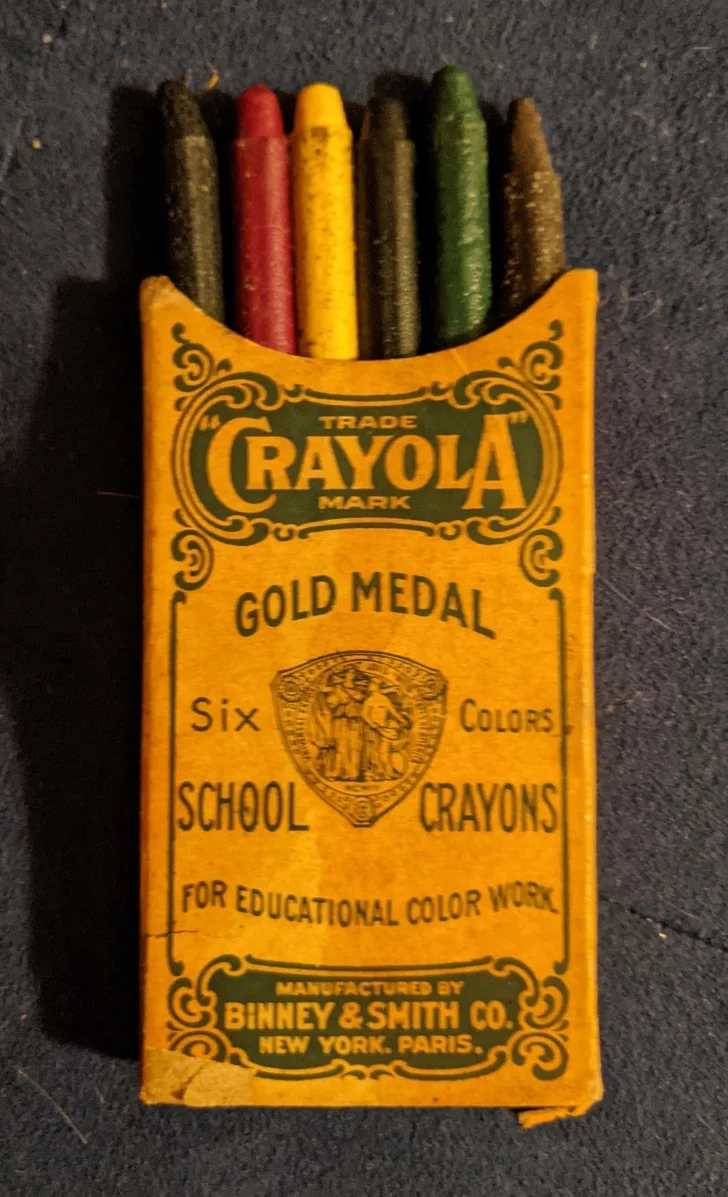
A box of Crayola crayons is a set of wax sticks in fixed colors, sized for a small hand and cheap enough to replace without ceremony. Crayola's own company history page states that Edwin Binney and his cousin C. Harold Smith had run a pigment business since 1885, making red oxide barn paint and carbon black for printing ink, before noticing, as the National Toy Hall of Fame's record puts it, that teachers complained about poor-quality classroom chalk. Adapting a black grease pencil the firm already made for marking shipping containers, Binney & Smith built a non-toxic wax crayon in eight colors, and Edwin's wife Alice Binney combined the French words for chalk and oily into the name Crayola.
What the evidence says
The two sources agree closely and add different details. Crayola's own history page dates the launch precisely, stating that 'in June 1903, Binney & Smith introduced the first box of eight affordable, non-toxic Crayola crayons,' and its 'Our Story' section states the box sold for five cents. The museum's record corroborates the same eight-color set and nickel price, describing it as a market entry rather than a lab discovery. Both are the company's and a museum's own accounts rather than independent chemical testing, so this entry treats founding-era details, such as the exact price, as what the company states about its own history.
Age fit and safety
Both sources describe the original crayons as 'non-toxic,' a claim this entry reports as the manufacturer's own historical description rather than a citation to any specific testing standard, since no such standard existed in 1903. Neither source states a numeric age range for the 1903 product. A wax crayon is a small, chewable object, so the same caregiver judgment that applies to any small art supply, checking whether a specific child still mouths objects, applies here regardless of the era-appropriate marketing language.
What to look for
This is editorial guidance: when buying crayons for a young child, a caregiver can check the current package for a modern non-toxicity certification mark rather than rely on either company history or a 1903-era claim, since certification standards have changed since Crayola's founding. Crayola's own history page notes the company also now manufactures Silly Putty, a reminder that a single brand's safety practices can span different product categories, each worth checking on its own current label.
- Does the current box carry a modern non-toxicity or art-material safety certification, not just a historical claim?
- Is the child old enough to use crayons without mouthing them?
- If buying a themed or collectible tin, is it meant for play or display?
A complaint about school chalk, a barn-paint chemist, and his wife's knack for naming things turned into a box that, by the company's own account, has been on shelves for more than a century.
Sources & reading trail
National Toy Hall of Fame record for Binney & Smith's 1903 introduction, the Alice Binney naming story, nickel price, and 1998 induction.
Source published: 20 August 2021 · Retrieved: 16 September 2026
Crayola's own company history page states the first box of eight crayons launched in June 1903 for five cents, with founding year 1885 and 2007 rename to Crayola LLC.
Source published: Not established · Retrieved: 16 September 2026
Standards, recall notices, studies and records establish the entry; the what-to-look-for reading is Toy Almanac editorial analysis. This retrospective draft does not imply the site published on the event date.