The play
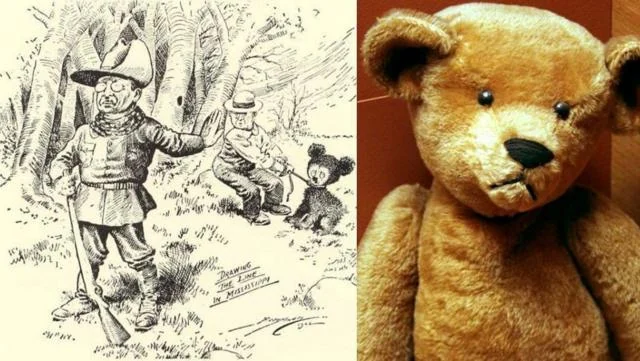
A teddy bear is a soft, jointed stuffed toy with movable arms and legs and a rounded face, sold as a cuddle toy rather than a play set with rules. The National Toy Hall of Fame's record traces the toy to a 1902 hunting trip on which President Theodore Roosevelt refused to shoot a bear that trackers had tied to a tree; cartoonist Clifford Berryman drew the incident for the Washington Post, and with Roosevelt's permission a Brooklyn candy-shop owner named Morris Michtom sewed a stuffed bear and called it 'Teddy's Bear.' The same year, in Germany, Steiff's own company history says its designer Richard Steiff had already created a jointed plush bear, the 'Bear 55 PB,' independently of the Roosevelt story.
What the evidence says
The two records this entry opened do not fully agree on the timeline. The museum treats the Roosevelt cartoon and Michtom's toy as roughly simultaneous with the 1902 hunt, and says Steiff 'began mass-producing copies in 1903.' Steiff's own history dates its design breakthrough, including an American dealer's order of 3,000 bears, to 1902, but places the specific story of the bear 'becoming the teddy bear' under a later year, 1906, crediting Roosevelt with starting a 'Teddy Boom.' Both sources agree an American and a German toymaker were making bears in the same window and that the cartoon supplied the name, but they place the naming's commercial effect on Steiff in different years, a gap this entry reports rather than resolves.
Age fit and safety
Neither record gives a numeric age range; a teddy bear of this era was a cuddle toy rather than an age-graded product in the modern sense. The features both sources describe, jointed limbs and, per Steiff's account, a mohair plush covering, point to considerations a caregiver would still check today: joints and any glass or plastic eyes are small-parts and attachment-strength concerns for an infant who mouths toys, though neither record states a hazard finding for any specific bear. This entry does not convert the toy's popularity into a safety judgment the sources do not make.
What to look for
This is editorial guidance: for an infant, a soft toy with securely fixed eyes and no small removable trim is generally more cautious than a jointed collectible bear built for display, and a caregiver should check the current age label rather than infer safety from the toy's long history. A vintage Steiff or antique bear, identifiable by Steiff's own account by the button fastened in its ear, is best treated as a collectible for supervised handling rather than a young child's everyday toy.
- Are the eyes and any trim on this bear fixed securely enough for a child who still mouths toys?
- Is a vintage or collectible bear intended for supervised handling rather than the toy box?
- Does the current age label match how the child will actually play with a huggable toy versus a display piece?
Two companies, an ocean apart, reached a jointed stuffed bear at nearly the same moment, and a president's refusal to shoot one gave the whole category its enduring name.
Sources & reading trail
National Toy Hall of Fame record for the 1902 Roosevelt hunting incident, Michtom's stuffed toy, and Steiff's 1903 mass production, plus 1998 induction.
Source published: 20 August 2021 · Retrieved: 16 September 2026
Steiff's own company history timeline for Richard Steiff's 1902 bear design and the American order, and its 1906 dating of the Roosevelt-driven 'Teddy Boom.'
Source published: Not established · Retrieved: 16 September 2026
Standards, recall notices, studies and records establish the entry; the what-to-look-for reading is Toy Almanac editorial analysis. This retrospective draft does not imply the site published on the event date.