The play
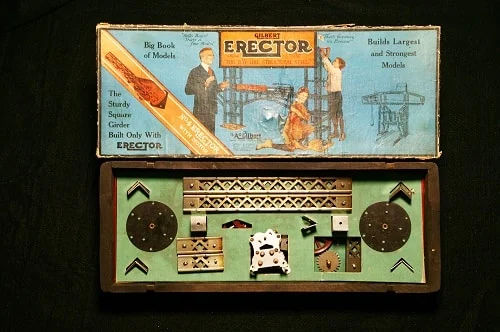
An Erector Set is a box of perforated steel strips, wheels, pulleys, and small nuts and bolts that a child bolts together into cranes, bridges, cars, or Ferris wheels. According to the National Toy Hall of Fame's own record, inventor A. C. Gilbert watched steel girders go up for power lines in 1911 and adapted that image into a building system, using sturdy one-inch square girders fastened with just two bolts, a simpler approach than Britain's earlier Meccano sets. A national advertising campaign in the Saturday Evening Post and Popular Mechanics, described by the museum as the first such campaign ever run for a toy, launched the Erector Set in 1913, with ads that addressed young readers directly: 'Hello, Boys! Make Lots of Toys!'
What the evidence says
The museum's record establishes the 1913 launch date, the two-bolt girder design, and the tone of the marketing, which it frames against a period when, in the museum's words, American society did not encourage girls to pursue technical careers. A separate living record, the current Erector and Meccano brand's own heritage page, corroborates the year, crediting 'Alfred Carlton Gilbert' with creating 'the first Erector Set for kids in the US' in 1913, and situates it against Frank Hornby's 1898 Meccano kit, the two brands a single company has licensed together since a 2000 merger. Neither record this entry could open states a specific patent number or filing date, so this entry does not name one.
Age fit and safety
Neither source gives a numeric age grade. The original marketing addressed 'boys' rather than a specific age band, a period convention this entry does not treat as a developmental finding. The set's own described materials point to the hazard profile worth checking: metal girders and small nuts and bolts are parts a caregiver of a young child should weigh against a modern age label, since loose fasteners that size can be a choking risk for a child who still mouths objects. The museum's record notes later changes, an electric motor and wartime wooden pieces, without stating a formal age range for any version.
What to look for
This is editorial guidance, not a citation-backed standard: a set built from small metal or plastic fasteners generally suits a child old enough to keep pieces out of their mouth, and a caregiver buying a modern reissue should check the current manufacturer's own age label rather than assume anything from this history. Treat an antique or vintage set, which predates any current toy-safety label, as a display or supervised-play piece rather than an everyday toy for a young child.
- Does a modern Erector-style set carry a current age grade that matches the child's age?
- Are the smallest bolts a size the supervising adult is confident a toddler cannot swallow?
- If buying a vintage set for display, is a young child likely to have unsupervised access to it?
A hundred years on, the durable part of the story is not a single patent but a marketing decision: Gilbert's 1913 campaign sold engineering play directly to children, a template construction toys still follow.
Sources & reading trail
National Toy Hall of Fame record for the 1913 national ad campaign, the two-bolt girder design, and 1998 induction.
Source published: 20 August 2021 · Retrieved: 16 September 2026
Current Erector/Meccano brand heritage timeline dates Alfred Carlton Gilbert's creation of the first Erector Set to 1913.
Source published: Not established · Retrieved: 16 September 2026
Standards, recall notices, studies and records establish the entry; the what-to-look-for reading is Toy Almanac editorial analysis. This retrospective draft does not imply the site published on the event date.