The play
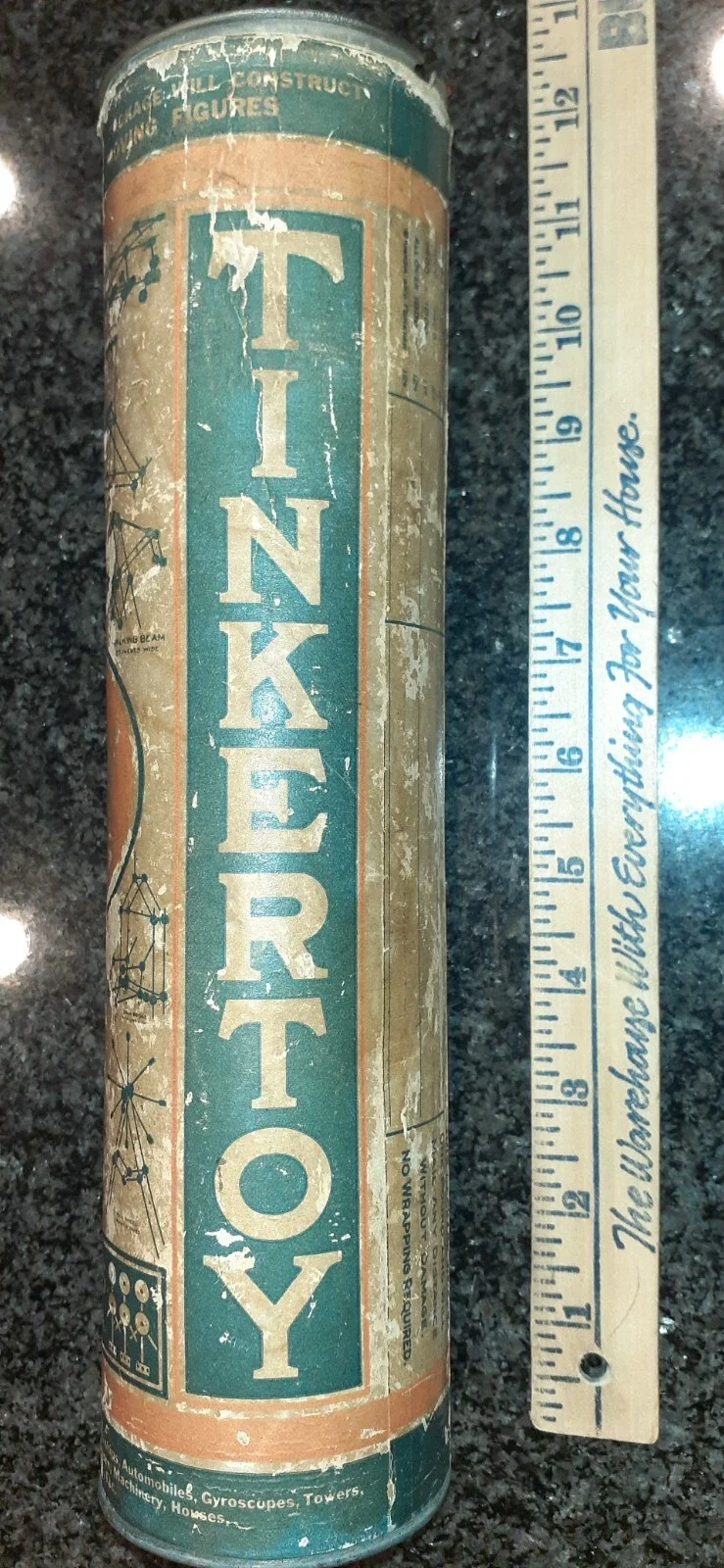
A Tinkertoy set is a box of wooden rods and round hubs drilled with holes on every face, so a child can push a rod into any hole and build an open lattice of shapes rather than a solid structure. The National Toy Hall of Fame's record credits stonemason Charles Pajeau and his partner Robert Petit with the idea, which the museum says grew from watching children build shapes from sticks, pencils, and old spools of thread; the pair drilled holes through a wooden wheel sized to the sticks in the set and called the result the 'Thousand Wonder Toy' before settling on the name Tinkertoy.
What the evidence says
The museum places the toy's creation in 'the early 1910s' without naming a single year, but its own account of a 1992 redesign made 'in honor of its 80th anniversary' points arithmetically to 1912 as the year the museum treats as the toy's origin. The toy's current manufacturer's product page instead markets Tinkertoy as a toy children 'have loved since 1913,' a year close to, but not the same as, the museum's implied date. Neither source this entry opened describes a New York toy-fair debut or names a patent or trademark filing, so this entry does not assert one.
Age fit and safety
Neither source gives a numeric age grade for the original toy. The museum's record notes the set was 'originally intended for younger boys' before an added electric motor, after 1919, drew in older children who wanted to build working models such as printing presses and power saws; that is a marketing description, not a tested age recommendation. A set of wooden rods and hubs carries a straightforward small-parts consideration: a caregiver of a child who still mouths objects should check the smallest rod and hub against a modern box's choking-hazard guidance, since neither museum nor manufacturer states one for the historical toy.
What to look for
This is editorial guidance rather than a citation-backed standard: an open-lattice building toy like Tinkertoy suits a child with the patience to fit a rod into a specific hole rather than simply stack pieces. A caregiver comparing a wooden heritage set with a modern colored-plastic version, which the museum notes arrived after Playskool's 1985 acquisition, might weigh splinter risk and rod thickness against the child's age. Check the current age label before buying, and store loose rods where a much younger sibling cannot reach them.
- Is the child ready to aim a rod into a specific hole, or would a simpler stacking toy suit them first?
- Does the household have a safe way to keep loose rods and hubs from a much younger child?
- Does a current set's age label match the manufacturer's own marketing claims about who the toy suits?
A century of retelling has left Tinkertoy's exact birth year soft at the edges, but the museum's and manufacturer's own numbers agree within a year of each other, which is about as close as an early-1910s toy story usually gets.
Sources & reading trail
National Toy Hall of Fame record crediting Pajeau and Petit with the 'early 1910s' toy, whose own 1992 80th-anniversary redesign date implies a 1912 origin, plus 1998 induction.
Source published: 20 August 2021 · Retrieved: 16 September 2026
Current manufacturer's product page dates Tinkertoy to 1913.
Source published: Not established · Retrieved: 16 September 2026
Standards, recall notices, studies and records establish the entry; the what-to-look-for reading is Toy Almanac editorial analysis. This retrospective draft does not imply the site published on the event date.