The play
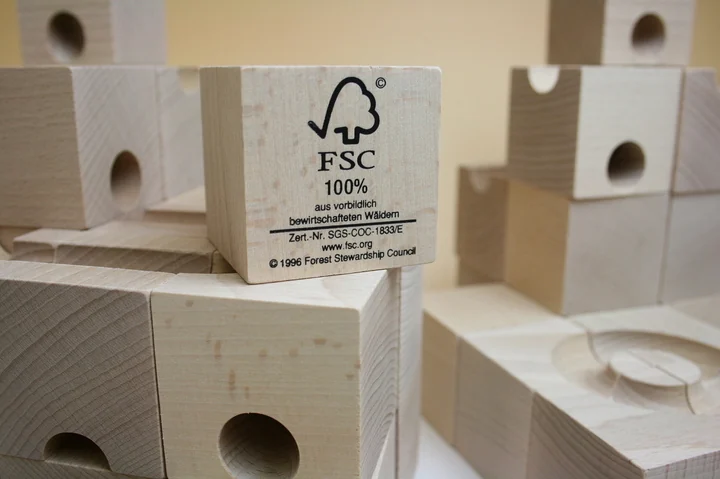
The Forest Stewardship Council is an international certification body for wood and forest products, and some wood-toy makers carry its label on packaging or product pages. A caregiver meets FSC as a small logo, usually alongside a claim that the wood came from a responsibly managed forest. As retrieved on 16 September 2026, FSC's own site describes two linked things: forest-management certification and chain-of-custody certification, which is the version most relevant to a finished toy.
What the evidence says
FSC's own overview describes certification as independent verification that forests or forest products meet its sustainability standards, covering categories including construction, furniture, and wood products; it does not list toys as a named category, though wood toys fall under general wood-product supply chains. Its dedicated chain-of-custody page is explicit about scope: it verifies that forest-based materials are credibly tracked from forest to finished good, and that FSC-certified material is identified through manufacturing and distribution. That page discusses labor standards, such as prohibitions on child and forced labor, alongside material tracking, but makes no reference to product safety testing, chemical content, or toxicity screening. In other words, an FSC label is a sourcing and traceability claim about where the wood came from and how it moved through the supply chain, not a statement about what finish, glue, or coating was later applied to the toy, or whether the finished product passed a chemical or mechanical safety test.
Age fit and safety
FSC's own materials describe no age range and make no safety finding; certification operates upstream of the safety testing a finished toy would separately need under a standard like ASTM F963 or the EU's chemical requirements. A wood toy carrying both an FSC label and a toy-safety test result is documented on two different questions, not one.
What to look for
This is an editorial reading of FSC's own scope statements. An FSC label is worth checking for what it actually is, chain-of-custody or forest-management certification, since the two verify different things. It is reasonable to treat FSC as good evidence about wood sourcing and separately look for a named chemical or safety standard to answer the finishing and testing question, rather than assuming one label covers both.
- Does the FSC claim specify chain-of-custody or forest-management certification, and can I tell the difference?
- Is there a separate, named safety or chemical standard cited for the finished toy?
- Am I reading a sourcing certification as if it were also a safety certification?
FSC's own scope language is the clearest guide here: it verifies where wood came from and how it was tracked, and that is a genuinely useful, separate fact from whether the finished toy is safe for a child to handle.
Sources & reading trail
FSC's own overview describes what certification verifies (responsible forest management, sustainable sourcing) and the industry categories it lists, which do not name toys specifically.
Source published: Not established · Retrieved: 16 September 2026
FSC's own scope statement for chain-of-custody certification: it tracks forest-based material from forest to finished good and covers labor standards, with no mention of product safety or chemical testing.
Source published: Not established · Retrieved: 16 September 2026
Standards, recall notices, studies and records establish the entry; the what-to-look-for reading is Toy Almanac editorial analysis. This retrospective draft does not imply the site published on the event date.