The play
PlanToys is a Thailand-based wooden-toy maker whose vehicles, blocks, and dollhouses are built from rubberwood, the timber of rubber trees that have stopped producing latex. This entry looks at what the company's own site discloses about that material and its finishing process, as retrieved on 16 September 2026, distinguishing the company's account of its own practice from any independent verification of it.
What the evidence says
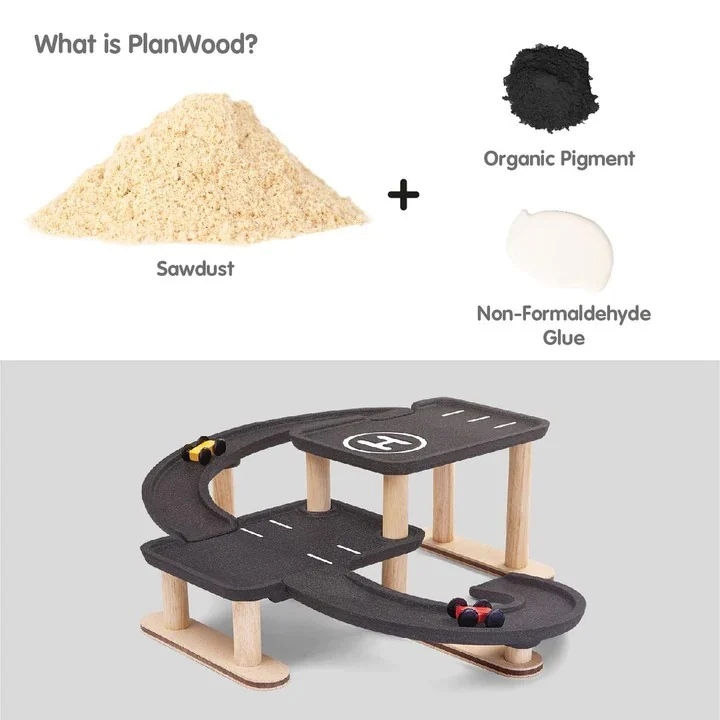
The company's own sustainable-materials page states that when rubber trees stop producing latex they are typically cut down and burned, and that PlanToys says it was the first toy manufacturer to build toys from this reclaimed rubberwood, starting in 1981, using a kiln-drying process rather than chemical treatment. The same page names its adhesive as a non-formaldehyde, no-added-formaldehyde glue described as having the lowest levels of formaldehyde, and describes its coloring as organic pigments and water-based dyes that carry color into the wood fiber. These are specific, checkable claims about material choice, considerably more detailed than a bare eco-friendly label. What the page does not do is link an independent test report; a check of the company's own sustainability page and its legal-compliance pages found no direct link to an ASTM or EN71 laboratory result, only general statements elsewhere about meeting or exceeding safety standards. A manufacturer's own account of its formaldehyde and pigment choices is real, useful disclosure, but it remains the manufacturer's own claim until matched to a named third-party test.
Age fit and safety
The sustainable-materials page states no age range and no specific hazard finding; it addresses material origin and processing, not a toy's mechanical or choking-hazard profile for a given age group. A caregiver checking age fit for a specific PlanToys item needs that item's own age label and, separately, a citation to a chemical or mechanical safety standard.
What to look for
This is an editorial distinction. A detailed material disclosure, naming the adhesive type and pigment method, is more specific and more checkable than a vague sustainable claim, and is worth more credit for that specificity. It is still the company's own account rather than a third-party laboratory result, so look separately for a named standard, such as a stated ASTM or EN71 test, before treating a chemical-safety question as settled.
- Does the material disclosure name the specific adhesive, pigment, or process, rather than a vague green label?
- Is there a named third-party standard or test report behind the safety claim, or only the company's own general assurance?
- Am I treating a detailed manufacturer disclosure as equivalent to independent verification?
PlanToys' own pages are a genuinely specific example of material disclosure, useful precisely because they name real choices, glue chemistry, pigment type, wood sourcing, while still requiring a separate, named citation for a true safety verdict.
Sources & reading trail
The company's own page describes reclaimed rubberwood sourcing since 1981, its kiln-drying process, its non-formaldehyde glue, and its organic-pigment and water-based-dye claims.
Source published: Not established · Retrieved: 16 September 2026
The company's own general sustainability page frames material choice as part of child, worker, and environmental safety, without naming a specific third-party test or standard.
Source published: Not established · Retrieved: 16 September 2026
Standards, recall notices, studies and records establish the entry; the what-to-look-for reading is Toy Almanac editorial analysis. This retrospective draft does not imply the site published on the event date.