The play
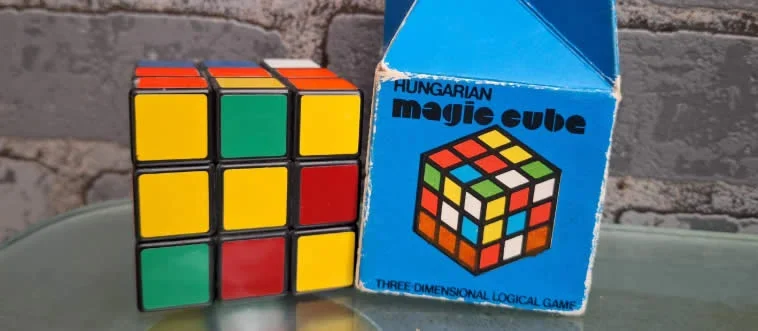
The toy is a hand-held cube of twenty-seven smaller cubes, each face showing one of six colors, that twists and rotates around a hidden internal pivot. The Strong National Museum of Play's own history states that Hungarian design teacher Erno Rubik assembled his first version, which he called the Magic Cube, in 1974, and that after a toy agent brought it to Ideal Toy and Novelty Company, the renamed Rubik's Cube reached store shelves in 1980. A caregiver encountering it today meets a puzzle, not a building set or a plush toy: there is one way to solve it and thousands of ways to scramble it, and the challenge is entirely mechanical and visual rather than narrative.
What the evidence says
The museum's account, retrieved 16 September 2026, credits the puzzle's geometry to Rubik's own design work, and notes that press coverage first suggested a teaching aid before Rubik said the geometry problem came first. A separate US patent record for a related spatial logical toy, assigned to Politoys Ipari Szovetkezet, the Hungarian cooperative tied to the puzzle's production, lists a Hungarian patent numbered HU170062B and dated 28 March 1977 among its foreign references. Neither document gives a dateless sales total; the museum instead states a bounded figure, that puzzlers bought about one hundred million cubes within two years of the 1980 launch, its own claim about that specific period rather than an audited industry count.
Age fit and safety
Neither source sets an age recommendation or a hazard finding for the cube. The museum describes 'young puzzlers' and notes that speed-solving records have been kept by the World Cube Association since 2003, which speaks to who enjoys the puzzle rather than a minimum age. The cube is built from twenty-seven pieces under spring tension; readers should treat the age grading on current retail packaging, set under standards not examined here, as the operative guidance rather than anything inferred from this history.
What to look for
This is editorial: a caregiver choosing a twist puzzle can use the museum's own framing of the play value, that the cube rewards pattern recognition its fans call algorithms, to judge whether a recipient enjoys sustained, solitary problem solving rather than open-ended pretend play. Because the patent record shows a manufacturing history predating today's licensed reissues, checking who currently makes a given cube, and whether its packaging carries an age and small-parts warning, is a step neither source cited here takes on its own.
- Does the puzzle's box state an age range, and does that match the household it is meant for?
- Is the appeal the mechanical challenge itself, or a licensed theme printed onto the same mechanism?
- Would the recipient rather solve a fixed puzzle repeatedly or build something new each time?
The record here is narrower than the legend: a museum names 1974 and 1980, and a patent filing ties the mechanism to a Hungarian manufacturing cooperative in the late 1970s, and both stop well short of certifying the puzzle for any particular age or explaining every figure attached to its early success.
Sources & reading trail
Museum's own account of Rubik assembling the cube in 1974 and Ideal Toy's 1980 store launch, plus a two-year sales figure.
Source published: 20 August 2021 · Retrieved: 16 September 2026
US patent record assigned to Politoys listing Hungarian patent HU170062B (1977) among its foreign references.
Source published: 29 March 1983 · Retrieved: 16 September 2026
Standards, recall notices, studies and records establish the entry; the what-to-look-for reading is Toy Almanac editorial analysis. This retrospective draft does not imply the site published on the event date.