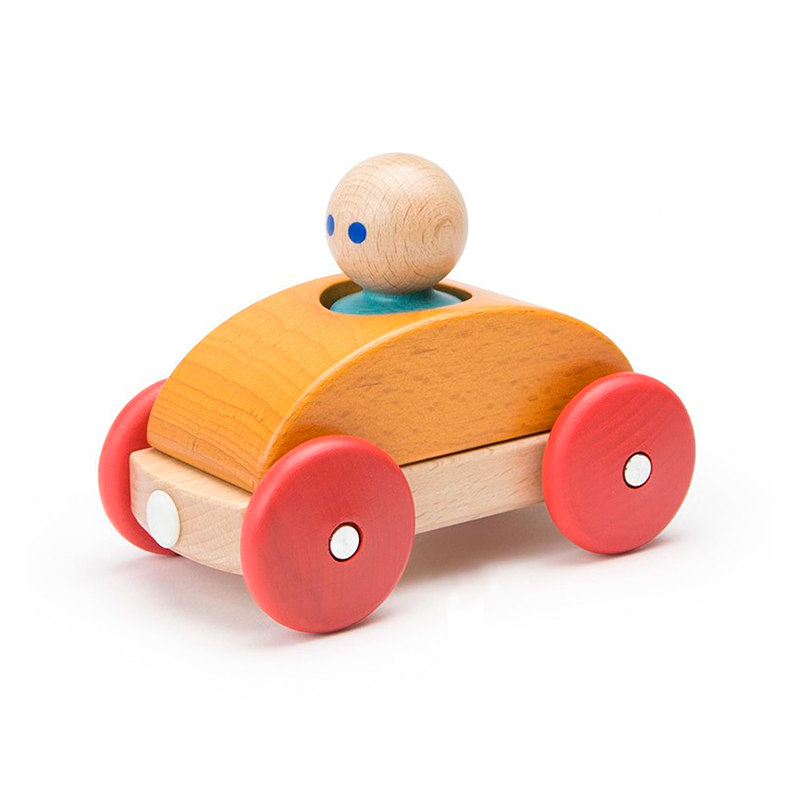
Give loved ones clear safety and household constraints, then let them choose generously inside those boundaries.
Why a brief is kinder than a vague request
Gift giving is easier when the caregiver replaces “anything is fine” with a few durable constraints. CPSC advises following age guidance and other safety information on packaging and choosing toys that match a child’s interests and abilities. For a young toddler, a giver may not know the home’s small-parts boundary, available storage, sound tolerance, sibling mix, or which play materials are already abundant. A brief makes those hidden facts available without grading the gift-giver’s taste.
Start with the non-negotiables: the child’s current age, “please follow the package age guidance,” “no loose small parts or high-powered magnets,” and “please avoid button-battery items unless the compartment is securely tool-closed.” Add household realities: maximum size, whether electronic sound is welcome, whether the item must fit a shelf or travel, and whether the family prefers one durable item, an experience, consumable art materials, or a contribution to a larger item.
Sources: Toys · Button Cell and Coin Batteries · Magnets
Use a ready-to-send checklist
Editorial suggestion: send this as a note: “For [child]: age [months]. Please use the package age guidance. Our hard nos are small loose parts, high-powered magnets, water beads, and anything with an accessible button battery. We have room for [size]. Sound preference: [quiet / volume control welcome / no electronic sound]. Current interests: [examples]. Helpful options: [open list]. Please include the receipt and keep packaging or model information with the gift.” The bracketed fields let the family decide their own limits without naming products or prices.
If a giver wants a surprise, offer a category rather than a specific item: board book, simple vehicle, drawing material with the relevant CPSC conformance statement, outdoor accessory, family museum membership, or a contribution toward a planned purchase. The point is not to make gifts more optimized. It is to reduce duplicates and safety mismatches while preserving the giver’s freedom to choose within a clear boundary.
Sources: Toys · Art Materials · Water Beads
Add a handover and recall step
Ask that the gift remain packaged until an adult can read the label, remove packaging, and inspect it. CPSC advises discarding plastic wrapping and other packaging promptly after gifts are opened because it can become a dangerous plaything. This is a useful boundary for celebrations, when several toys may be opened at once and caregivers are understandably stretched between guests, meals, and children.
Editorial suggestion: after the event, add the item’s brand and model to a household list and check CPSC recalls before regular use, especially for a secondhand or unfamiliar item. If the brief feels too formal, keep only three lines: age boundary, hard nos, and one current interest. A short, repeatable note is more likely to be used than a perfect wish list. It also avoids promising that any gift will teach, soothe, or produce a milestone.
Sources: Toys · Recalls & Product Safety Warnings
Sources & limits
Practical setups are editorial suggestions. Research findings apply to the populations and conditions studied; they are not product tests by Toy Almanac.
- Toys ↗
CPSC consumer guidance to follow age and safety information, avoid small parts for children under three, and discard packaging.
Checked 2026-09-19 - Button Cell and Coin Batteries ↗
CPSC guidance on secure battery closures, loose-cell handling, emergency contacts, immediate care, and the cited honey guidance for children 12 months and older.
Checked 2026-09-19 - Magnets ↗
CPSC guidance on high-powered magnets, ingestion risks, symptoms, X-ray caveat, and immediate medical attention.
Checked 2026-09-19 - Art Materials ↗
CPSC requirements and explanation for ASTM D-4236 conformance statements and hazard labeling.
Checked 2026-09-19 - Water Beads ↗
CPSC water-bead safety information used for the gift-brief exclusion list.
Checked 2026-09-19 - Recalls & Product Safety Warnings ↗
CPSC searchable recalls and warnings database, update cadence, and consumer-action information.
Checked 2026-09-19