On low-energy days, a safe small setup and a few responsive moments are enough; rest is part of a sustainable routine.
Choose a seated setup
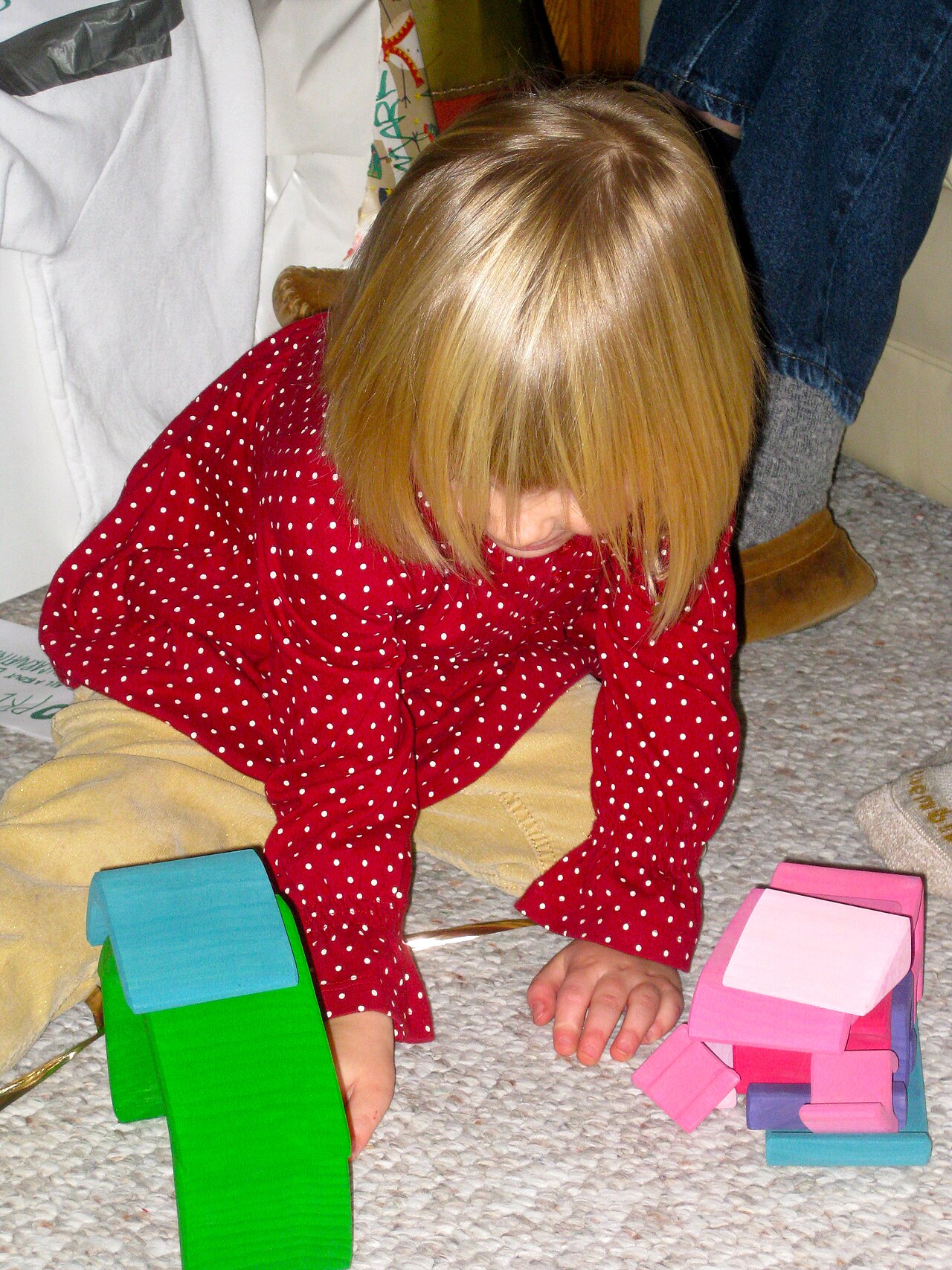
Pick one safe activity you can supervise while seated on the floor, couch, or a sturdy chair: rolling a ball back and forth, reading a short board book, placing large blocks in a basket, looking at family photos, or lining up a few toy animals. Put away distracting extras first. A small setup helps the adult notice what the child is doing without having to manage a whole room of toys.
AAP toy guidance emphasizes that human interaction matters in play, and Harvard’s serve-and-return framework describes responsive back-and-forth around a child’s looks, gestures, sounds, and actions. Neither source requires constant animation. A nod, a comment—‘you found the dog’—or rolling the ball back can be a genuine response when it is possible.
Sources: Selecting Appropriate Toys for Young Children in the Digital Era · Serve and Return: Back-and-forth exchanges
Use low-demand ways to be together
Editorial suggestion: make a ‘you play, I notice’ routine. Say, ‘I am right here while you build.’ Describe one action every so often, then be quiet. Let the child bring you an item if they want a turn with you. You can also repeat a familiar song without adding movement, or read the same two pages more than once. Repetition is allowed; variety is not a moral requirement.
If you need to lie down, stay awake, alert, and able to intervene while the child is within safe supervision. Remove items that need close physical handling. Do not set up activities with loose small pieces, magnets, batteries, water, food sensory materials, climbing, or anything requiring an alert adult to intervene quickly. If you cannot supervise alertly, ask a responsible, capable adult to take over rather than treating a contained activity as sufficient. Choosing a quieter activity is a safety decision, not a lesser version of caregiving.
Sources: Toy Safety · Button Cell and Coin Battery Information Center
Lower the plan before you lower the connection
Limited energy can come from an ordinary hard day, illness, disability, stress, pregnancy, or a need for rest. This guide does not assume why a caregiver has less capacity and does not offer treatment advice. If the day calls for a snack, a cuddle, looking out the window, and an early cleanup, that is a workable day. Children do not need an adult to turn every available minute into enrichment.
When another responsible, capable adult is available, it is reasonable to transfer active-play supervision after they agree and can attend to the child. An older sibling can join the game, but is not a substitute for responsible adult supervision. When no adult is available, simplify the environment and the expectation. The practical goal is safe supervision plus a few responsive moments, not a fixed amount of play or an outcome a caregiver must produce. Keep a small ‘easy day’ basket in one familiar place so you do not have to invent an activity when you are already depleted.
If you may fall asleep or cannot respond promptly, arrange for a responsible, capable adult to take over. A quiet or contained activity does not replace supervision. This is not a failure of imagination. Adults’ limits are real information for planning the day, and a child benefits from a routine that stays safe and honest.
Sources: Serve and Return: Back-and-forth exchanges · Selecting Appropriate Toys for Young Children in the Digital Era
Sources & limits
Practical setups are editorial suggestions. Research findings apply to the populations and conditions studied; they are not product tests by Toy Almanac.
- Selecting Appropriate Toys for Young Children in the Digital Era ↗
AAP clinical report on play, caregiver interaction, toy choice, and limits of developmental toy claims.
Source date: 2019-01 · Checked 2026-09-19 - Serve and Return: Back-and-forth exchanges ↗
Center on the Developing Child explanation of responsive exchanges around young children’s sounds, gestures, and expressions; not a developmental assessment.
Checked 2026-09-19 - Toy Safety ↗
Current CPSC consumer guidance on age labels, small parts, inspection, and common toy hazards.
Checked 2026-09-19 - Button Cell and Coin Battery Information Center ↗
Current CPSC guidance on the serious ingestion risk posed by button and coin batteries and the need for secured battery compartments.
Checked 2026-09-19